Research

“More is different.”

— Philip W. Anderson

Galileo Galilei in Complex Science

Complex systems, especially human behavior, economic systems, and social dynamics, are often difficult to predict and hard to falsify. I aim to change this.

Behavior Learning research figure

Behavior Learning (BL)

Ma ZhenYao, Yue Liang, Dongxu Li · International Conference on Learning Representations (ICLR)

Abstract

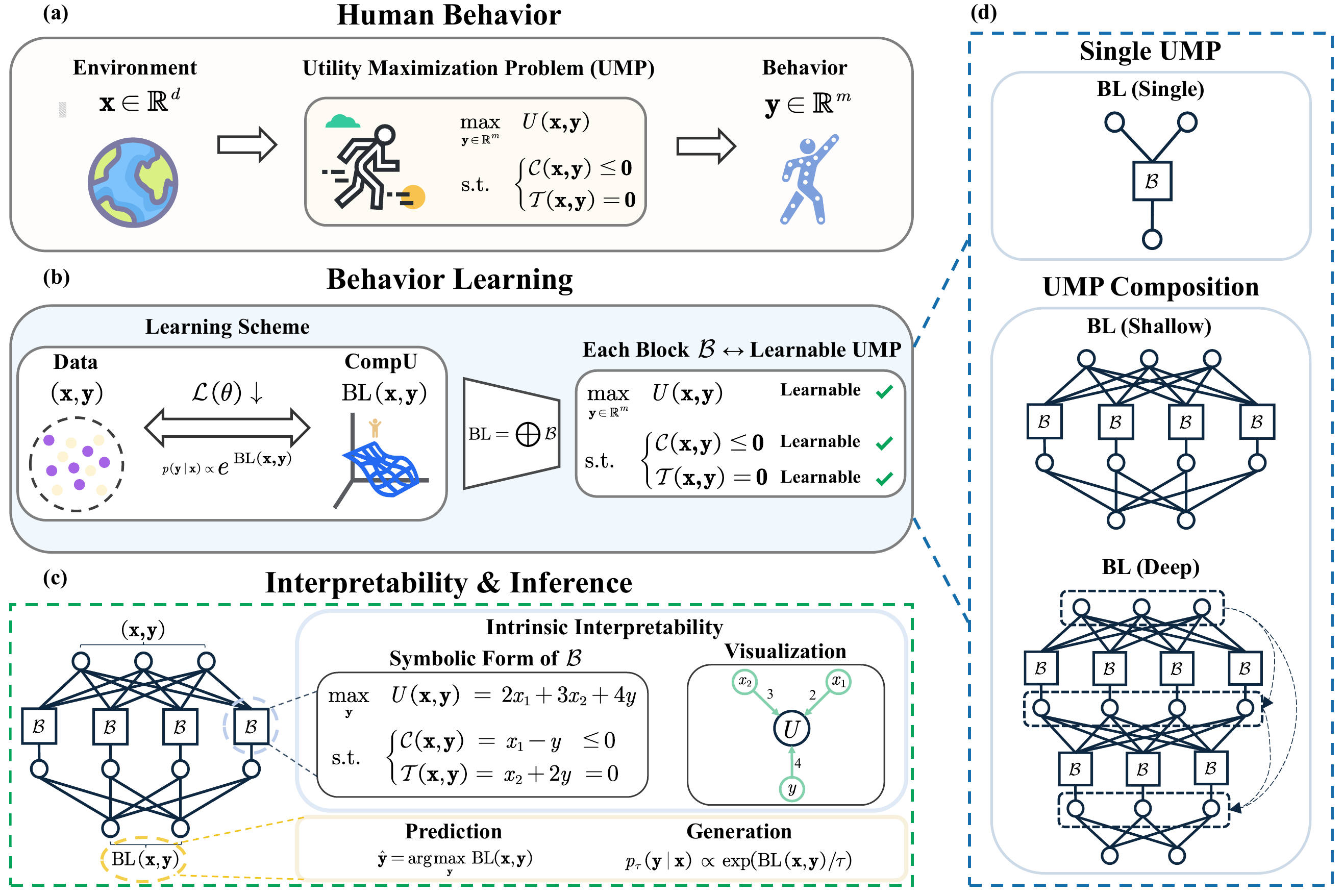
Inspired by behavioral science, we propose Behavior Learning (BL), a novel general-purpose machine learning framework that learns interpretable and identifiable optimization structures from data, ranging from single optimization problems to hierarchical compositions. It unifies predictive performance, intrinsic interpretability, and identifiability, with broad applicability to scientific domains involving optimization. BL parameterizes a compositional utility function built from intrinsically interpretable modular blocks, which induces a data distribution for prediction and generation. Each block represents and can be written in symbolic form as a utility maximization problem (UMP), a foundational paradigm in behavioral science and a universal framework of optimization. BL supports architectures ranging from a single UMP to hierarchical compositions, the latter modeling hierarchical optimization structures. Its smooth and monotone variant (IBL) guarantees identifiability. Theoretically, we establish the universal approximation property of BL, and analyze the M-estimation properties of IBL. Empirically, BL demonstrates strong predictive performance, intrinsic interpretability and scalability to high-dimensional data.
Automated Optimization Scientific Discovery research figure

Automated Optimization Scientific Discovery

Ma ZhenYao, Yue Liang · Working Paper

Abstract

Many scientific phenomena can be modelled as outcomes of optimization. We introduce OptScientist, a novel automated framework for Optimization Scientific Law Discovery. OptScientist comprises a model that discovers compact symbolic optimization problems from data and an automated research agent that embeds the model in a loop of theory priors, law discovery, mechanism abstraction and new-data proposals. On OptFeynman, a novel benchmark of 99 physics-derived optimization problems, OptScientist recovers ground-truth laws on over 80% of tasks and remains robust to context noise. In two real-world tasks, it discovers symbolic optimization laws for human risky choice and central-bank monetary policy, achieving state-of-the-art-level held-out performance with near-minimal parameter counts.

Albert Einstein under Complexity

What are scientific laws under complexity? We seek to understand the microscopic, macroscopic, and emergent processes within complex systems.

Human Social Preferences complexity figure

Human Social Preferences in Simple and Complex Decisions

With Sen Geng and Menglong Guan · Working Paper, 2026

Abstract

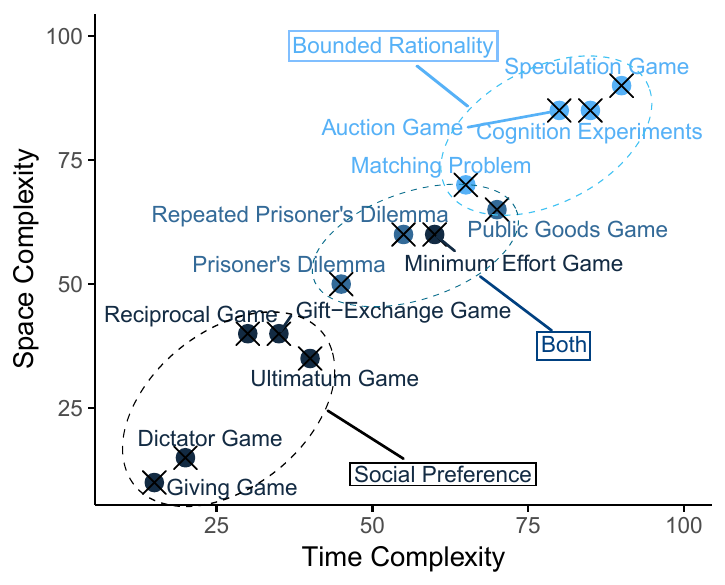
We develop a rational-choice framework to explain why behavior may fluctuate between selfish and prosocial even when underlying preferences remain stable. Decision-makers endogenously determine the informativeness of their mental representations for both material and social payoffs. We show that as the complexity of the decision environment—whether individual or strategic—increases, the expression of social preferences (active social consideration) is endogenously suppressed. In high-complexity environments, decision makers revert to a default strategy of pure self-interest. Our results suggest that the erosion of prosociality in complex settings reflects a rational adaptation to cognitive costs of deliberation rather than a fundamental shift in preferences.

AI for Human Well-Being

AI is significantly shaping human life. We are committed to ensuring that AI serves human well-being.